
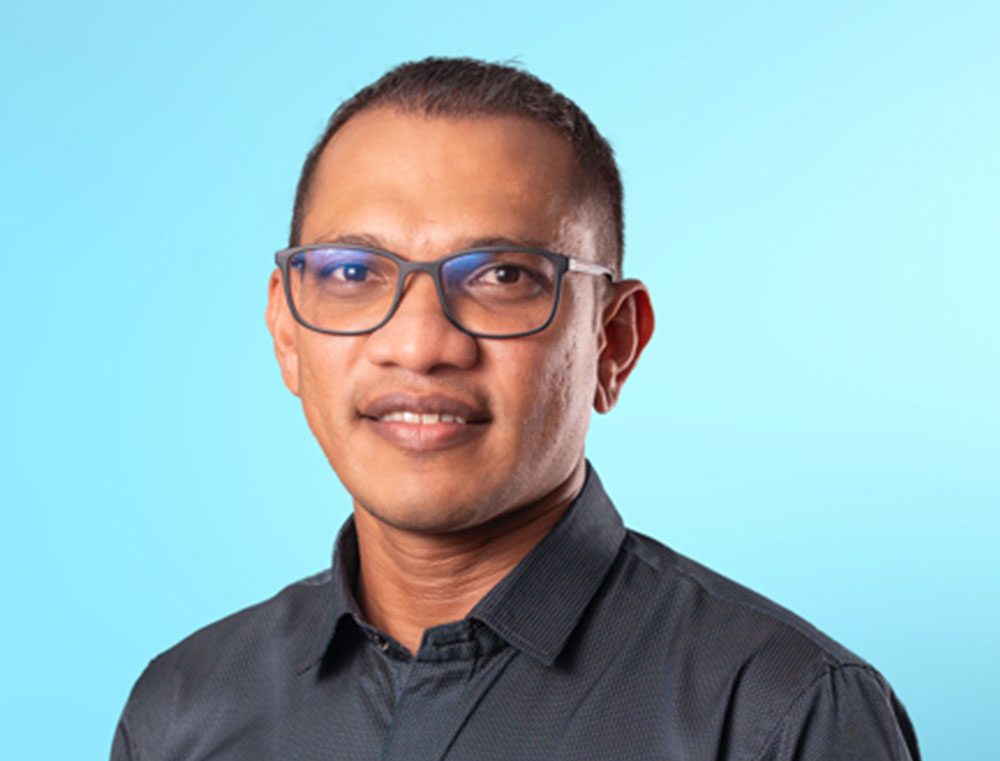
Dr. Manoj S
Senior Consultant – Vitreoretinal Surgeon
Education
MBBS / DNB (Ophthalmology)
FVRS / FRCS (Glasgow)
Experience
20+ years
Visiting Specialist · Chaithanya Eye Hospital & Research Institute, India
Consulting from 11–15 October 2026
Location: EyeCare Hospital, Orchid Magu, Malé
About
Dr. Manoj S is an accredited senior vitreoretinal surgeon and Head of Vitreoretinal Services at Chaithanya Eye Hospital and Research Institute, Trivandrum, where he is also Director of Research. With over 20 years of experience, he specialises in complex retinal conditions, including diabetic retinopathy, macular diseases, retinal detachment and inherited retinal diseases.
He completed his vitreoretinal fellowship at Aravind Eye Hospital, Madurai, and has undertaken observerships at leading international centres, including the Wilmer Eye Institute (Johns Hopkins, USA) and New York-Presbyterian Weill Cornell Medical Center. He is actively involved in clinical research and in training retina fellows.
Achievements
- Head of Vitreoretinal Services and Director of Research, Chaithanya Eye Hospital and Research Institute
- Dr. S. Natarajan Award for Best Paper in Retina, AIOC 2012
- Multiple best paper awards at DRISHTI–KSOS (2008, 2011, 2012)
- Investigator in international clinical trials on retinal vein occlusion, diabetic macular edema and AMD
Specialisation
- Medical & Surgical
- Retina
- Diabetic Retinopathy
- Macular Diseases
- Retinal Detachment
- Surgery
- Retinal Laser
- Uveitis
- Inherited Retinal
- Diseases
- Advanced Retinal Imaging & Electrophysiology
Qualifications
- MBBS – JIPMER, Pondicherry
- DNB Ophthalmology – Aravind Eye Hospital, Madurai
- Fellowship in Vitreoretinal Surgery (FVRS) – Aravind Eye Hospital, Madurai
- FRCS – Royal College of Physicians and Surgeons, Glasgow
- MNAMS, FICO (Switzerland)
Language Spoken
- English
- Hindi

Request for Consultation
Other Doctors

Elit anim nisi ut commodo esse sunt minim sed officia cillum qui do ullamco commodo proident.
Dr. Arjun Malla Bhari

Elit anim nisi ut commodo esse sunt minim sed officia cillum qui do ullamco commodo proident.
Dr. Mohamed Azzam
Elit anim nisi ut commodo esse sunt minim sed officia cillum qui do ullamco commodo proident.
Dr. Mandhoof Moosa

Elit anim nisi ut commodo esse sunt minim sed officia cillum qui do ullamco commodo proident.
Dr. Vijayamani Janampalli
Frequently Asked Questions
A. People with diabetes, sudden floaters or flashes of light, a curtain or shadow over their vision, distorted central vision, or a family history of retinal disease should have their retina examined by a specialist.
A. Most people with diabetes should have a dilated retina examination at least once a year, even if their vision seems normal, because diabetic retinopathy often has no early symptoms.
A. Yes. Sudden flashes, a shower of floaters or a shadow spreading across your vision need urgent assessment, because early treatment gives the best chance of saving sight.
A. The eye is numbed with anaesthetic drops before the injection, so most patients feel only mild pressure. The procedure takes a few minutes.